Our philosophy
Trade, simply put, hasn't changed in 50,000 years. Our ancestors bartered stone tools, ostrich egg beads and paints sourced from minerals and materials. Then, as now, trade follows the same shape: a journey from point A to point B — or A to B to C, or A to B to C to D.
What has fundamentally changed is demand, and with it supply. Trade routes have grown in distance, in modes of transport, in quantity and in capacity. That has pushed everyone in the supply and distribution chain to develop standards, technologies and organisational processes to manage capacity, reduce time constraints and lower the cost to the end consumer — all of it tied to one word: efficiency.
At the same time we have built barriers between countries for security, tax and the protection of industry, adding further inspection and further delay.
Global trade in goods and services in 2025 — a record
Merchandise exports alone
Shipping containers moving through ports every year
What is the problem we have now?
From 50,000 years ago to today, one thing remains the same: there is a start point and an end point — or, most painfully, returns, losses and damaged goods. And they all lead back to the same causalities:
- Lack of visibility
- Lack of communication
- Lack of collaboration
- Increased barriers to geographic entry
- Multiple data points and translation requirements
One delay — from your supplier, your mode of transport, a border entry or paperwork that isn't uniform — has a domino effect. Not only on you, but on whole industries, on countries, and on the neighbour who may be feeling the same effects from the same border stop or the same delayed driver at a shared transport company.
Our approach: what we do
While every company competes for market share, they usually forget they share the same supply and distribution chain process with their neighbours, their competitors and aligned industries. What really matters to your end customer is on-time delivery, pricing and transparency.
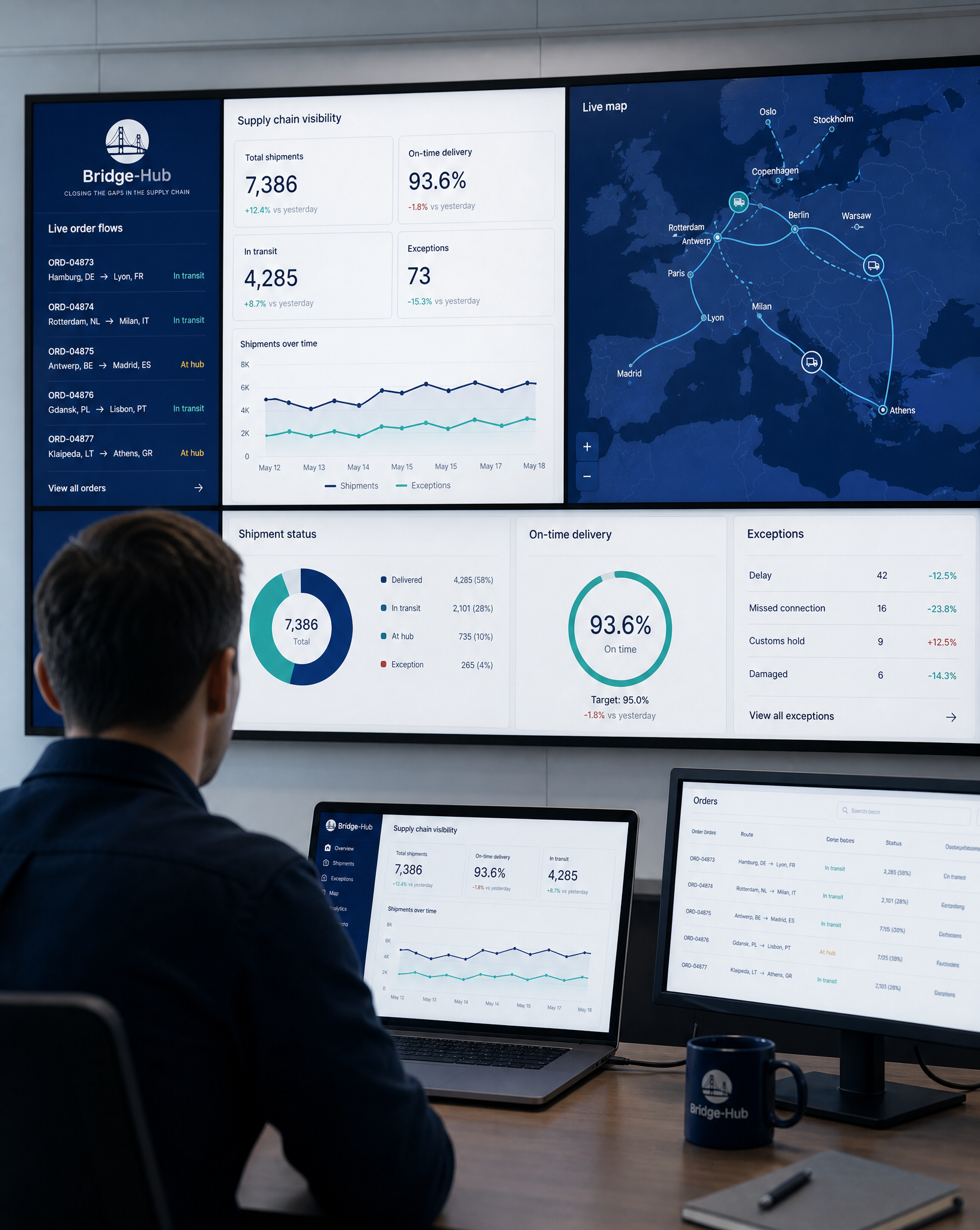
We give you that collaboration in your supply chain — safeguarding your market share while securing your supply and distribution chain through encrypted shared-data aggregation, a live model of your own operation, and automated workflows that streamline communication and daily tasks between your internal teams and every stakeholder in your chain, globally.
Why Bridge HUB exists
Goods still move through Europe on a patchwork of phone calls, spreadsheets and systems that don't talk to each other. Warehouses count stock by hand. Drivers get schedules by email. Customs paperwork arrives late, wrong, or both. Every handover is a gap, and every gap costs time, money and trust.
Bridge HUB closes those gaps. We build a live model of how your operation actually runs — reconstructed from the documents that moved through it and the people who executed it — then build the event logs and workflows that should have existed, so every party in the chain works from the same picture.
What we build
Core is the living model, and it comes first. Where the diagnosis concludes a system should be replaced, we supply it — warehouse management and inventory first, then asset management, freight forwarding and customs. Where you keep what you already run, we build and manage the connectors instead. Either way, role-based dashboards give your team, your logistics partners and your customs brokers exactly the view they need, and nothing more.
Security by design: token-based access means each role sees only what they need. You hold the encryption keys — Bridge HUB never holds personal data in the clear. EU-native architecture, built for GDPR and EU data sovereignty from day one.
Where we're headed
We're launching with a select group of pilot partners across Denmark, Netherlands and Germany — 3PL warehouses, SME manufacturers and brands, logistics companies, freight forwarders and customs brokers. As EU regulation like the Digital Product Passport makes item-level traceability mandatory, we're building the infrastructure operators will need to comply — and to compete.